Buying guide · August 15, 2026
How to Choose an Embroidery Machine for Business
An embroidery machine becomes a business asset only when its field, hoop access, needle workflow, and operator labor match products customers already order.
By EquipmentSelect Editorial
Start with the products you sell
List recurring placements and dimensions: left-chest logos, jacket backs, pockets, sleeves, caps, bags, patches, and flat goods. Field size matters for design dimensions; free-arm access matters for reaching tubular or enclosed items.
Buy needle count from color-change labor
A multi-needle machine keeps several colors threaded, reducing operator intervention on repeat multicolor designs. Single-needle machines cost less and can validate demand, but every thread change adds handling time. Model the actual color count and weekly job volume.
Separate field size from physical access
A large flatbed field can handle oversized flat designs but does not automatically fit pockets, sleeves, or finished bags. A free-arm machine can improve access even with a similar stated field. Compare both constraints independently.
Price hooping, digitizing, and operator time
Include digitizing software or services, hoops and fixtures, cap systems, stabilizer, thread, needles, bobbins, test sew-outs, trimming, and rejected garments. The machine price alone does not represent the production cell.
Use a measured step-up path
Start compact only when the product catalog fits the hoop. Step to a larger flatbed when field size blocks orders, to free-arm when access blocks placements, and to multi-needle when color-change labor and queue time are already paid constraints.
Model it: Equipment ROI Calculator
Needle count and hoop access only pay back when repeat jobs cover the extra capital.
Related equipment
 Baby LockEquipmentSelect Score 8.4/ 10
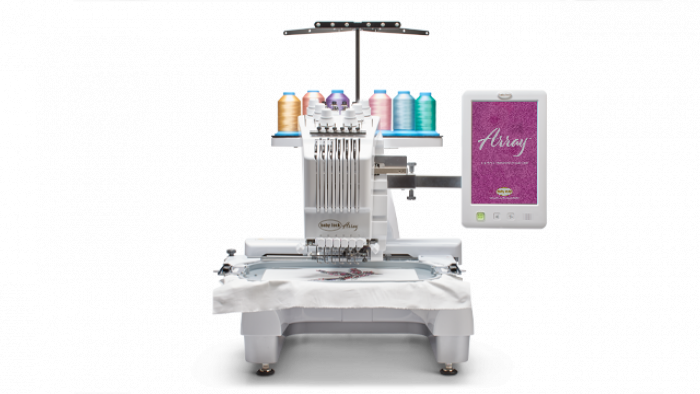
Baby Lock Array
Best for · Six-needle repeat logo and apparel work
Six-needle Baby Lock embroidery system for small-shop production and repeat color work.
Needle class
multi
Machine type
multi-needle
Embroidery width
7.875 in
Starting at
$14,574.00
 Baby LockEquipmentSelect Score 8.1/ 10
Baby Lock Capella
Best for · Free-arm pockets, sleeves, bags, and hats
Business-oriented single-needle free-arm machine for pockets, sleeves, bags, and hats.
Needle class
single
Machine type
free-arm
Embroidery width
7.875 in
Starting at
$8,029.00
 Baby LockEquipmentSelect Score 7.9/ 10
Baby Lock Meridian 2
Best for · Large-field single-needle embroidery
Large-field embroidery-only flatbed for oversized layouts and design-heavy work.
Needle class
single
Machine type
flatbed
Embroidery width
9.5 in
Starting at
$9,349.00
 Baby LockEquipmentSelect Score 7.6/ 10
Baby Lock Flare
Best for · Midrange embroidery-only business entry
Midrange embroidery-only machine with a practical 6-1/4 × 10-1/4 inch field.
Needle class
single
Machine type
flatbed
Embroidery width
6.25 in
Starting at
$2,529.00
 Baby LockEquipmentSelect Score 6.8/ 10
Baby Lock Aurora
Best for · Compact 4 × 4 embroidery validation
Compact hybrid entry for validating small-format embroidery demand.
Needle class
single
Machine type
flatbed
Embroidery width
4 in
Starting at
$1,319.00
$8,359.00
 BrotherEquipmentSelect Score 7.8/ 10
Brother Entrepreneur PR1X
Best for · Tubular single-needle personalization
Single-needle free-arm embroidery machine with an 8 × 12 inch field, 1,000-spm speed, and crosshair positioning laser.
Needle class
single
Machine type
free-arm
Embroidery width
8 in
Starting at
$6,999.99
$11,899.99
 BrotherEquipmentSelect Score 8.3/ 10
Brother Entrepreneur PR680W
Best for · Six-needle connected embroidery production
Six-needle embroidery machine with an 8 × 12 inch field, 1,000-spm speed, wireless transfer, and crosshair positioning.
Needle class
multi
Machine type
multi-needle
Embroidery width
8 in
Starting at
$12,999.99
$16,719.99
 JanomeEquipmentSelect Score 7.3/ 10
Janome MB-4Se
Best for · Entry four-needle embroidery production
Four-needle embroidery machine with a 9.46 × 7.88 inch maximum field, 800-spm speed, and Tajima DST compatibility.
Needle class
multi
Machine type
multi-needle
Embroidery width
9.46 in
Starting at
$4,999.00
$8,499.00
 JanomeEquipmentSelect Score 7.9/ 10
Janome MB-7
Best for · Compact seven-needle small-shop production
Seven-needle embroidery machine with a 9.4 × 7.9 inch field, 800-spm speed, remote screen, and DST support.
Needle class
multi
Machine type
multi-needle
Embroidery width
9.4 in
Starting at
$5,999.00
$10,649.00
Frequently asked questions
Is a six-needle machine six times faster?
No. Multiple needles mainly reduce thread-change labor. Stitch speed, hooping, loading, trimming, design complexity, and one-head-at-a-time garment handling still determine throughput.
Should a new shop start with a 4 × 4 inch field?
Only if the validated catalog fits that field. It can work for small monograms and patches, but many common apparel designs require a larger hoop, making an early upgrade likely.
Do I need a free-arm machine for hats?
Free-arm access can help, but hat production also depends on compatible cap frames, drivers, hooping technique, and design constraints. Verify the full cap workflow on the exact machine.
Related research
Category
Related products
- Baby Lock Array
Six-needle Baby Lock embroidery system for small-shop production and repeat color work.
- Baby Lock Capella
Business-oriented single-needle free-arm machine for pockets, sleeves, bags, and hats.
- Baby Lock Meridian 2
Large-field embroidery-only flatbed for oversized layouts and design-heavy work.
- Baby Lock Flare
Midrange embroidery-only machine with a practical 6-1/4 × 10-1/4 inch field.
- Baby Lock Aurora
Compact hybrid entry for validating small-format embroidery demand.
- Brother Entrepreneur PR1X
Single-needle free-arm embroidery machine with an 8 × 12 inch field, 1,000-spm speed, and crosshair positioning laser.
Comparisons
- Baby Lock Array vs Capella
Compare Baby Lock's six-needle Array with the single-needle free-arm Capella for shops choosing color-change efficiency versus lower-capital access to difficult items.
- Baby Lock Meridian 2 vs Flare
Compare Baby Lock's embroidery-only flatbeds: large-field Meridian 2 versus lower-cost Flare for shops sizing field requirements before they buy.
- Baby Lock Capella vs Flare
Compare Baby Lock's free-arm Capella with the embroidery-only flatbed Flare for shops choosing tubular-item access versus lower-capital flat work.
- Baby Lock Array vs Meridian 2
Compare Baby Lock's six-needle Array with the large-field single-needle Meridian 2 for shops choosing color-change throughput versus oversized layouts.
- Baby Lock Aurora vs Flare
Compare Baby Lock's compact sewing-and-embroidery Aurora with the embroidery-only Flare for buyers deciding between validation capital and a working field.
- Baby Lock Capella vs Brother PR1X
Compare single-needle free-arm peers—Baby Lock Capella and Brother Entrepreneur PR1X—for hats, bags, sleeves, and pockets.
- Baby Lock Array vs Brother PR680W
Compare six-needle peers—Baby Lock Array and Brother Entrepreneur PR680W—for shops buying color-change labor, not a first validation machine.
- Janome MB-4Se vs MB-7
Compare Janome's four-needle MB-4Se with the seven-needle MB-7 for small shops stepping into multi-needle production on a shared field class.
Use cases
Decision tools
- Equipment Match
Shortlist machines from your constraints
- Cost Calculator
Model first-year cost, setup, and cost per unit
- Job Pricing Calculator
Recommend a customer price from labor and margin
- Profit Calculator
Estimate monthly and annual operating profit
- ROI Calculator
Estimate payback and annual ROI